Why Car AC Fails in an Arkansas Summer, and What Fixing It Actually Involves
Refrigerant doesn't get used up the way oil does, so if your AC is weak, something is leaking, not just running low on its own.
September 2, 2026 · 4 min read
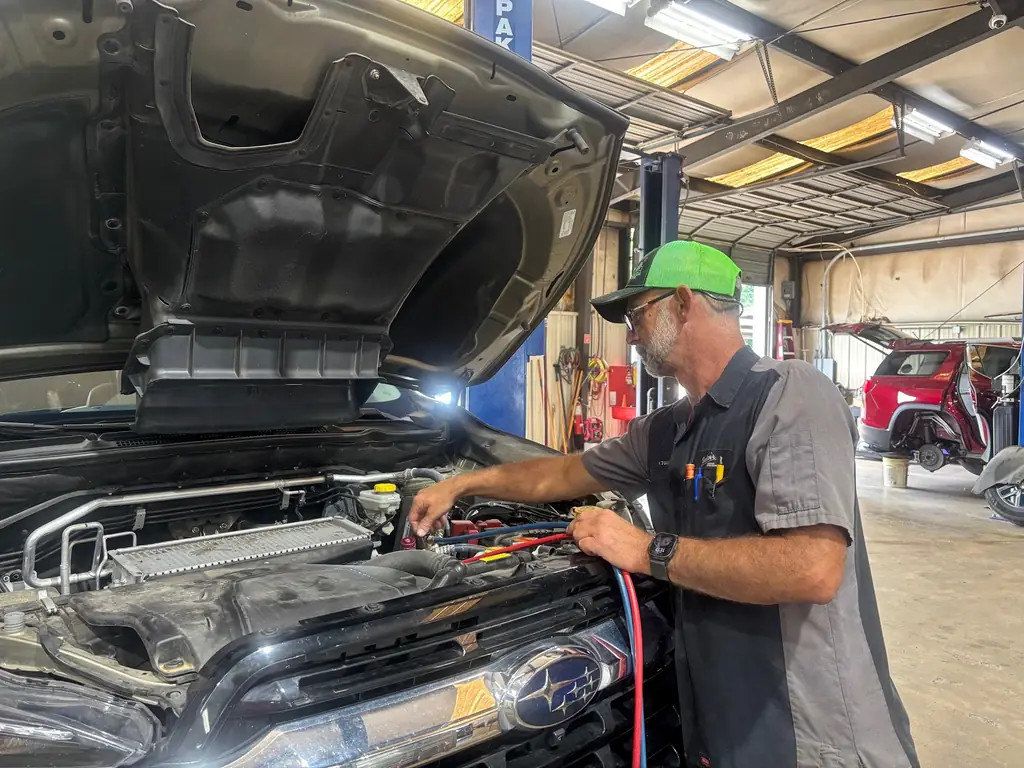
There's a particular kind of disappointment in reaching for the AC on a hundred degree Saline County afternoon and getting warm air instead of cold. Car air conditioning problems are one of the most common reasons vehicles come through our door in the summer months, and most of them trace back to the same handful of causes.
Arkansas Summers Are Genuinely Hard on AC Systems
Central Arkansas doesn't do mild summers. Long stretches of heat and humidity put more continuous demand on a car's air conditioning system than milder climates do, and that extra runtime accelerates wear on every component in the loop: the compressor, the seals, the hoses. A system that would limp along fine in a cooler climate for years starts showing its weak points here in July and August.
Refrigerant Is Not Something You Top Up Like Oil
This is probably the most common misunderstanding we run into. Motor oil burns off and gets consumed over time as part of normal engine operation, so topping it up between changes is normal and expected. Refrigerant doesn't work that way. A sealed, properly functioning air conditioning system doesn't consume refrigerant. If your system is low, refrigerant went somewhere, and that somewhere is a leak. Adding refrigerant to a system with a leak buys you a few weeks or months of cold air and then you're back to warm air again, plus you still have a leak that's now slowly releasing refrigerant into the air. A proper A/C service finds the leak first, then recharges the system to the correct level, which matters because both too little and too much refrigerant hurt cooling performance and can damage the compressor.
The Parts That Actually Make Cold Air
An air conditioning system is a loop, and cold air at the vents depends on several parts doing their job in sequence. The compressor pressurizes the refrigerant and is the heart of the system. If it fails, nothing else matters. The condenser, mounted at the front of the car in the airflow, sheds heat from the pressurized refrigerant, which is why a condenser packed with road debris or bent fins cools poorly even with everything else working. The evaporator, inside the dash, is where the refrigerant actually absorbs heat from the cabin air passing over it, that's the part making your air cold. A leak, blockage, or failure at any one of these shows up the same way to you: warm air at the vents, even though the actual cause could be in any of three very different places.
There are also two different refrigerant types in use on the road today, older R-134a and the newer R-1234yf found on many vehicles built in the last several years, and they aren't interchangeable. Using the wrong refrigerant, or mixing the two, doesn't just fail to fix the problem, it can damage seals and components that weren't designed for it. Knowing which one your car takes matters before anyone touches the system.
The Cabin Air Filter Is Part of This System Too
It doesn't cool anything itself, but a clogged cabin air filter restricts airflow through the evaporator housing, which can mean weak airflow even when the system underneath is cooling correctly. It's a cheap, easy thing to check and often gets overlooked because it's not visible without popping the glovebox out.
Why Running Weak AC Is Worse Than It Sounds
A system that's low on refrigerant makes the compressor work harder to try to hit the same cooling target, and refrigerant also carries the oil that lubricates the compressor internally. Run a system low for long enough and you're not just accepting weaker cooling, you're accelerating wear on the single most expensive part in the whole system. Catching a small leak early is a far smaller job than replacing a compressor that seized from running dry.
Signs Your AC Needs a Real Look
- Air blows but isn't cold, or takes much longer than it used to
- Warm air on one side of the car, a blend door or duct issue, or warm air on both sides
- A clicking or grinding noise when the AC is switched on
- A musty smell through the vents, often the cabin filter or evaporator
- Visible oily residue around AC lines or under the front of the car, a leak signature, since refrigerant oil leaves a trace
If your AC is blowing anything less than genuinely cold air, it's worth having it looked at before the Arkansas heat makes the drive to Benton, Bryant, or Salem miserable. Give Baxley's Auto Repair a call at (501) 466-7483 and we'll find out what's actually going on before anything gets added or replaced.
Baxley's Auto Repair — (501) 466-7483
Call (501) 466-7483More articles
What Your Check Engine Light Is Actually Telling You
The light looks the same whether it's a loose gas cap or a real problem, so here's how to tell the difference before you spend a dime.
The Brake Symptoms Worth Acting On This Week
A squeal is an early warning built into the pad on purpose, a grind means that warning already passed.